


 04-02-2026
The digital landscape shifts fast. What worked in 2024 is already outdated. Now we are in 2026, the standard for a “perfect” website has moved beyond just looking good. It requires intelligence, speed, and a user experience that feels almost invisible.
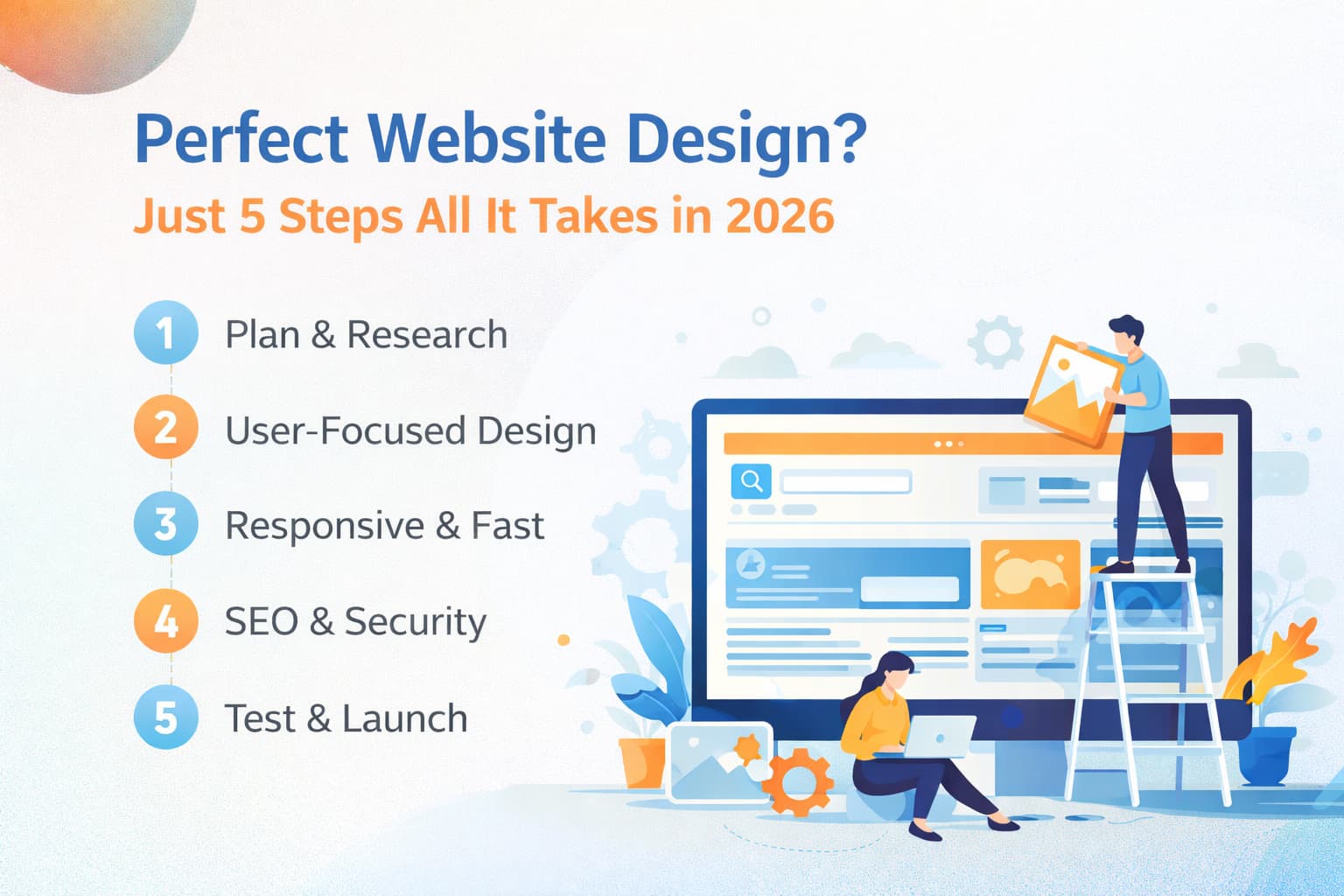
Business owners often dread the web design process. They imagine months of back-and-forth emails, missed deadlines, and a final product that doesn’t quite work on mobile. But it doesn’t have to be that way. In fact, if you strip away the jargon and the fluff, the path to a high-performing website really comes down to five distinct, manageable steps.
At Webriderz, our team has refined this process. We know that an ecommerce web development in 2026 isn’t just a digital brochure. It is a 24/7 salesperson. It is the face of your brand. Here is how the perfect website comes together in just five steps this year.
Step 1: Strategic Planning and Intelligent Goal Setting
You cannot build a house without a blueprint. You definitely cannot build a successful website without a strategy. In the past, “planning” just meant deciding which pages you wanted—Home, About, Contact.
In 2026, planning is data-driven.
Before a single pixel is there, we have to ask the hard questions. Who is actually visiting the site? What specific problem are they trying to solve right now? The mistake many make is focusing on what they want to tell the customer, rather than what the customer needs to hear.
This phase involves creating a sitemap, sure. But it also involves mapping the “user journey.” We look at the path a visitor takes from the moment they land on the site to the moment they click “Buy” or “Contact Us.”
How Webriderz Help You Here
We also lean on modern tools. AI-driven insights help us understand competitor strategies faster than ever. We analyze search intent. We look at market gaps. If you run a custom e-commerce store, we figure out exactly why a user might abandon their cart and plan the site architecture to prevent it. Contact us today to hire webflow developer.
Key Actions in This Step:
- Defining the primary conversion goal (e.g., lead generation vs. direct sales).
- Analyzing competitor websites to identify what they lack.
- Drafting a sitemap that prioritizes easy navigation.
- Selecting the right technology stack (Shopify, WordPress, Laravel, or Custom PHP).
Step 2: Visual Direction and Brand Alignment
Once we know what we are building, we decide how it feels.
Design is subjective. One person’s “modern” is another person’s “boring.” That is why this step is critical. It bridges the gap between your vision and the designer’s execution. We don’t just guess. We explore.
In 2026, design trends favor authenticity. Users are tired of stock photos that look fake. They want real connections. We focus on creating a “Moodboard”—a collection of colors, typography, and imagery that sets the tone.
Are you a high-energy tech startup? Your site might need bold, high-contrast colors and sharp, sans-serif fonts. Are you a luxury wellness brand? You likely need softer palettes, ample whitespace, and elegant serif typography.
How Webriderz Help You Here
This is also where we lock in the “Integrity” of the design. A perfect website maintains consistency. The font size on the homepage must match the font size on the contact page. The button styles must be uniform. These small details signal professionalism. If the visual identity is scattered, trust erodes. We ensure your brand voice is loud and clear, visually speaking. Get in touch and hire HubSpot developer.
Key Actions in This Step:
- Curating moodboards to agree on a visual style.
- Selecting a color palette that supports accessibility and brand psychology.
- Choosing typography that is legible across all devices.
- Planning custom graphics or photography to avoid generic stock assets.
Step 3: Wireframing and User Experience (UX) Architecture
This is the skeleton.
Imagine trying to paint the walls of a house before the drywall is up. That is what happens when you design without a wireframe. A wireframe is a low-fidelity, black-and-white blueprint of your website. It shows where the buttons go, where the text sits, and how the menu works.
We strip away the distraction of color and images to focus purely on usability.
In 2026, UX is everything. A pretty site that is hard to use is a failed site. We prioritize “Mobile-First” thinking. Most users will likely see your website on a phone screen, not a desktop monitor. If the thumbs cannot easily reach the buttons, you lose customers.
How Webriderz Help You Here
We map out the content hierarchy. The most important information goes “above the fold” (the part of the screen you see without scrolling). We ensure that contact forms are easy to find. We make sure the “Call to Action” (CTA) is clear.
Key Actions in This Step:
- Sketching low-fidelity layouts for key pages.
- Designing for mobile screens first, then scaling up to desktop.
- Placing CTAs strategically to guide user behavior.
- Removing clutter that doesn’t support the user’s goal.
Step 4: High-Fidelity Design and Robust Development
Now, the magic happens. We combine the strategy, the visual style, and the wireframe into the final product.
First, the UI (User Interface) designers apply the colors, images, and fonts to the wireframes. The black-and-white sketches transform into vibrant, interactive mockups. You get to see exactly what the finished site will look like.
Once the design is approved, our developers take over. This is the engine room. At Webriderz, we pride ourselves on writing clean, semantic code.
Why does code quality matter? Because Google cares.
Messy code makes a website slow. Slow websites get ranked lower in search results. In 2026, a site that takes more than two seconds to load is often abandoned. We optimize images and minify scripts. We ensure the site is secure (HTTPS is a standard, not a luxury).
How Webriderz Help You Here
Whether we are building a complex SaaS application, a dynamic Shopify store, or a corporate WordPress site, the development principles remain the same: Speed, Security, and Scalability. We build the site so it can grow with you.
Key Actions in This Step:
- Turning UI designs into functional code (HTML/CSS/JS/PHP).
- Implementing the CMS (WordPress, Shopify, Webflow, etc.).
- Ensuring total responsiveness across all screen sizes (tablets, phones, huge monitors).
Optimizing site speed and performance (caching, image compression).
Step 5: Testing, Launch, and Future-Proofing
The site is built. But we aren’t done.
Launching a website without testing is reckless. We put the site through a rigorous Quality Assurance (QA) process. Our team test it on iPhones. We test it on Androids. Then we check it on Chrome, Safari, and Firefox. We try to break the forms.
We catch the bugs so your customers never do.
Once the site is polished and perfect, we launch. But in 2026, a launch is just the beginning. The internet changes. New devices come out. Google updates its algorithm. A “perfect” website requires maintenance
This includes setting up analytics so we can track who is visiting and what they are doing. It means planning for updates. Maybe in six months, you want to add a blog or a new product line. Because we planned for this in Step 1, the site is ready to evolve.
How Webriderz Help You Here
We also focus on the “human” element of the handoff. Our team shows you how to use your new platform. We don’t just hand over the keys and disappear; we offer post-launch support to ensure your digital business card remains a powerful asset. Hire PHP developer at Webriderz.
Key Actions in This Step:
- Cross-browser and cross-device testing.
- Setting up Google Analytics and Search Console.
- Training the client on how to update content.
- Establishing a maintenance plan for security updates and backups.